

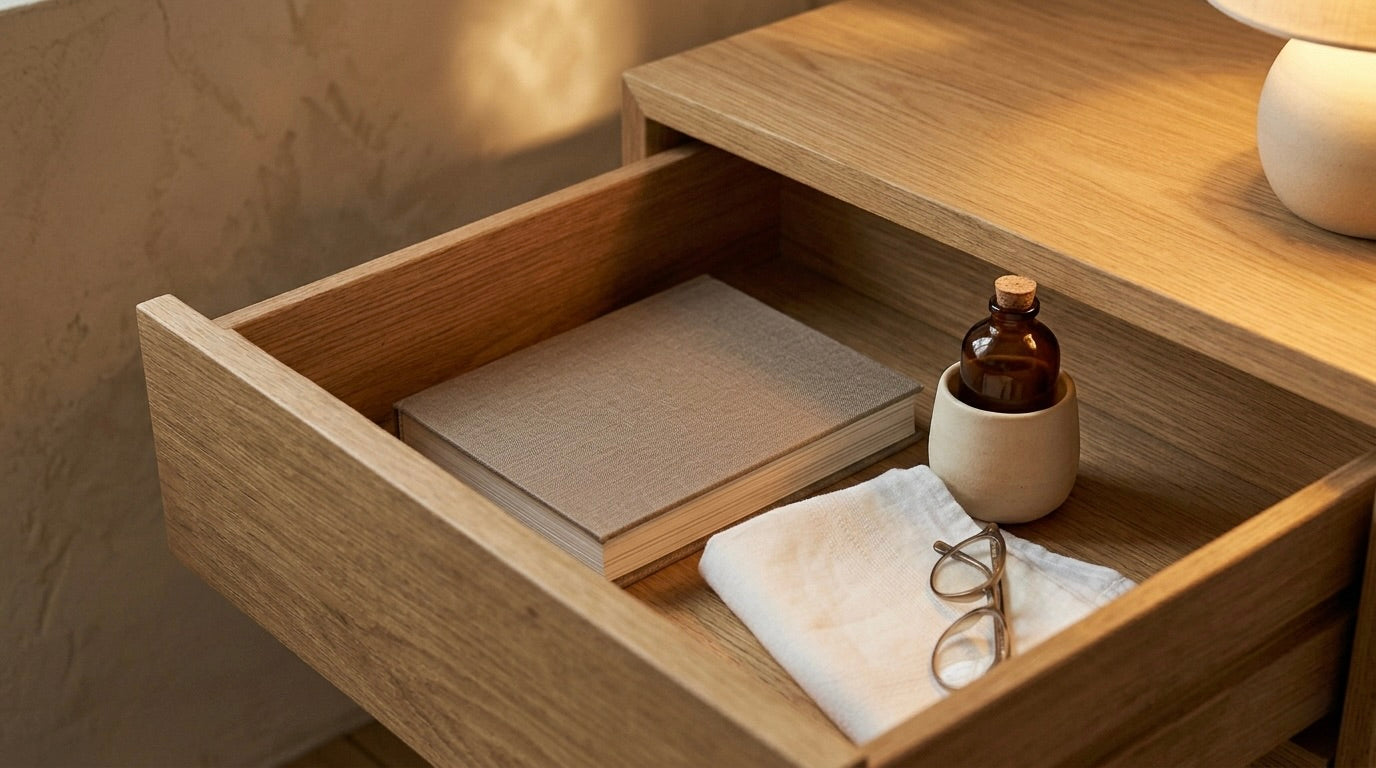
There's a small assumption built into most of the marketing for couples-oriented intimate products: that partnered intimacy and solo intimacy are competing categories. That the existence of one threatens the other. That a partnered person who maintains a solo intimate practice is somehow undermining the partnership.
This assumption is almost universal in the category, and it's almost universally wrong.
The relationships that hold up over decades tend to be the ones where both partners have a separate, fully respected solo practice. The two aren't in competition. They're complementary. And both partners knowing this, openly, is a sign of a relationship that's been allowed to mature past the early-years assumption that all intimacy has to be shared to count.
This is the conversation the category mostly avoids. It's worth having.
The category myth
For decades, the messaging around couples and intimate products has implied that solo use is something to either hide from a partner, or replace with partnered use — the "couples toy" sold as the natural upgrade. Both framings treat solo intimacy as a phase to grow out of, or a betrayal to manage.
Neither is accurate. Relationship therapists and sex educators have for years said the opposite: solo intimacy is a stable, healthy, lifelong part of adult life, partnered or not. Removing it from a partnered person's life doesn't deepen the partnership. It usually does the reverse.
The reason is simple. Adults who have a solo practice know their own bodies. They know what they want. They can communicate it more accurately to a partner. They're not relying on the partner to provide all of their intimate experience, which removes a pressure the partnership can't sustainably carry.
What healthy solo wellness in partnership looks like
A few characteristics:
It's known about, not hidden. Both partners are aware that the other has a solo practice. Neither asks for specifics. Neither feels threatened. The knowledge sits underneath the relationship the way other private practices do — like reading, like running, like therapy.
It uses its own objects. Some intimate objects belong specifically to solo use, and others to partnered use. The categorisation isn't strict, but it tends to exist. A device that lives in one partner's drawer, used alone, isn't the same object as the candle that gets lit on shared evenings.
It happens on its own schedule. Solo practice isn't scheduled around the partnership. It happens when it happens — usually in the small gaps of life where one partner is travelling, or working late, or simply doing something else. It doesn't compete for shared time.
It isn't a backup. Solo practice isn't what you do when partnered intimacy isn't available. It's its own thing. People who treat it as a substitute usually find it unsatisfying, because it isn't one. It's a different kind of attention to the body, with its own value.
Why partners benefit
Reduced pressure. No single person can or should be responsible for all of another adult's intimate satisfaction. Solo practice spreads the load, which makes the partnered intimacy that does happen feel less like a duty and more like a choice.
Better communication. A partner who knows their own body can articulate what they want. A partner who relies entirely on the relationship to figure out their preferences often can't.
More attention, not less. Counterintuitively, partners with solo practices often bring more attention to partnered intimacy. The partnered context can be about presence and depth rather than being the only outlet for desire.
Permission to evolve. Bodies change. Preferences shift. Hormonal cycles, age, and life circumstances all affect what feels good in a given week. Solo practice creates space to discover these shifts privately, which means the partnered context isn't always trying to keep up with changes neither partner has yet articulated.
What the partnered drawer might contain
For a couple in a long partnership, the intimate drawer often holds a mix:
A device or two that's primarily one partner's solo object. Used alone, in the small private windows of life. Not commented on by the other.
A device or two that belongs to partnered evenings — usually something quieter and smaller, designed to add to existing intimacy rather than dominate. A wearable device, a ring, an object that integrates rather than substitutes.
Some shared accessories: candles, oils, soft fabrics, perhaps a blindfold. These belong to neither partner specifically. They're the room's furniture.
A water-based lubricant, usually unmentioned, used in both contexts.
Some things solo. Some things partnered. Some things shared. No strict categorisation. No defensive boundary-keeping. Just two adults who have learned how to be in partnership without erasing their own private bodies.
What this looks like, practically
If you're in a long partnership and one or both of you doesn't currently have a solo practice, the most useful change is the smallest: permission.
Permission for each partner to have their own intimate life, on their own schedule, with their own objects, without disclosure or apology. Not as a secret. Not as a threat. Just as a fact about adult life.
The conversation, if it needs to happen, can be very short. Most partners, given explicit permission, are relieved rather than threatened. The implicit assumption that they had to provide everything was the actual burden. Removing it strengthens the partnership.
The objects that support this are the same objects already on the shelf. There is no "solo wellness for partnered people" as a separate category. There are good devices, considered lubricants, and small accessories. What the customer does with them — alone, partnered, or both — is her own business.
A final note
The category has been clumsy about this for a long time. Most brands either over-emphasise the couples context, implying solo is a problem, or treat solo and partnered as separate marketing buckets, implying they don't intersect. Neither matches how adult intimate life actually works.
We write about it the way we'd write about anything else — with the assumption that the customer is an adult, that her intimate life is hers to organise, and that the objects we sell should serve whatever shape her practice takes.
The drawer holds what works. The practice is yours.
